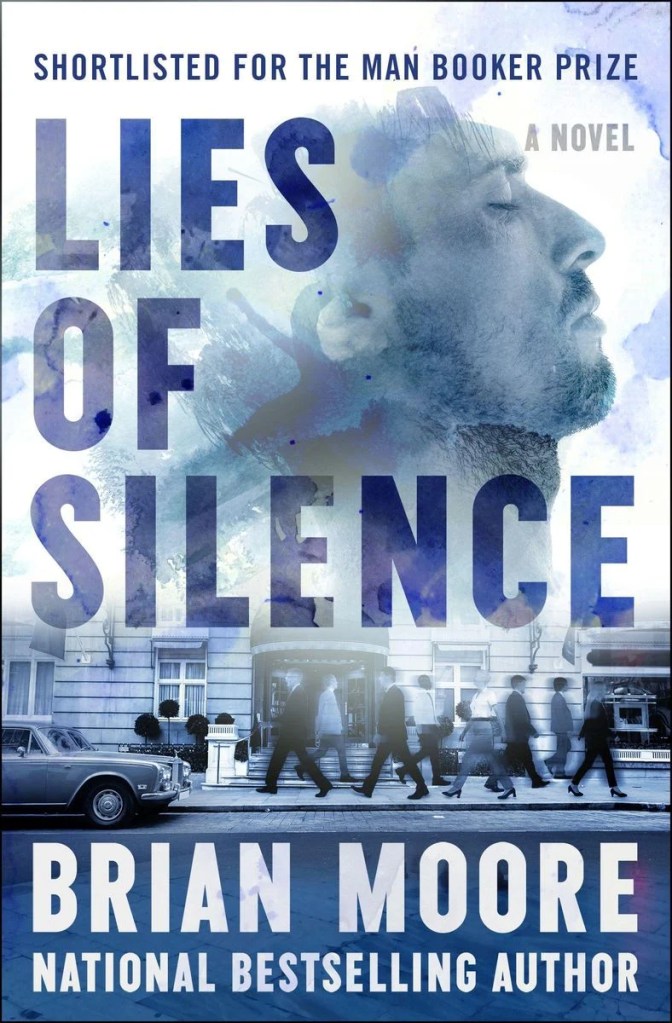
Lies of Silence by Brian Moore is a gripping novel set in Northern Ireland during a time of political unrest. It follows a man caught between personal loyalty and larger conflicts, as he faces a life-changing decision under intense pressure. The story explores themes of silence, moral choices, identity, and the cost of staying neutral in a divided society.
SOME INFO ABOUT THE AUTHOR : BRIAN MOORE
- Moore was born in Ireland in 1921
- He never got to complete his formal education because of World War II (1939-1945)
- He travelled through 17 countries from 1943 to 1948 working for the British government and the United Nations and free-lancing as a reporter
- He lived in Canada for some time, where he worked as a proofreader for the Montreal Gazette
- It was at this time he began to write short stories and fiction
- He lived the rest of his life in California
- Some major themes Moore explored in his 17 novels is the psychological dilemma caused by conflicting values the main character(s) must face
SOCIAL AND CULTURAL CONTEXT OF THE STORY LIES OF SILENCE
- Lies of Silence, published in 1990, takes place during the conflict in Northern Ireland
- Ireland was Christianized in the 5th century by Saint Patrick
- In the centuries that followed, it was invaded by the Vikings and the Normans
- In the 17th century, English and Scottish settlers—mostly Protestants—began colonizing Ireland, particularly the northern region. They acquired land and wealth, while the native Irish population, largely Catholic, remained poor and were often reduced to tenant farming
- This created deep economic inequality and religious tension between Protestants and Catholics
- From 1845 to 1849, the Great Potato Famine devastated the Irish Catholic population, causing mass starvation and emigration. The famine further widened the gap between the impoverished Irish Catholics and the English ruling class
- This suffering fueled political awareness and resistance among Catholics, who began demanding independence from British rule, which had governed Ireland since the 18th century
- In 1919, a national vote led to the independence of most of Ireland, forming what is now the Republic of Ireland. However, Northern Ireland remained part of the United Kingdom, with a Protestant majority and a significant Catholic minority
- Since then, many Catholics in Northern Ireland have continued to seek unification with the Republic. Out of this desire, the Irish Republican Army (IRA) emerged—an armed group committed to achieving Irish unity through violent means
PART ONE
- We are introduced to Michael Dillon, a hotel manager
- Michael sees himself as a failed poet in a business suit
- He feels trapped between his career, his failing marriage, and the political tension around him
- After another day of work at the hotel, during a busy week (since it is graduation week)
- Michael leaves the hotel and passes the security gate where the cars that enter are being checked and searched. We learn that the hotel has been bombed the previous year
- He goes to meet Andrea, a woman 12 years younger than him
- The meeting of Andrea and Michael
- They have met at the hotel bar, a busy student bar. The hotel has arranged conference rooms for an Arts Council symposium of Scottish and Irish poets. Andrea got to interview Michael. We learn that she works for the BBC
- Andrea revealed her feelings first, after a couple months of dating
- About Andrea Baxter:
- She is Canadian
- She had come to Northern Ireland four years ago because of her father, a Canadian engineer who accepted a two-year contract with Short’s, the aircraft people
- When her parents had returned to Canada she stayed on to finish her arts degree
- She has an ex-boyfriend who we do not know about for now
- They talk about their plan to leave for London, where Andrea has an opportunity to get a job as a head researcher for a new national art programme
- Michael is motivated to leave with her and to announce Moira, his wife, their divorce
- He also says that he wont have a problem finding a job in London, since Keogh’s there. A Yank in charge of all of their hotels in Europe and who asked Michael to manage the Clarence (a hotel in Belfast, which is in Northern Ireland — part of the United Kingdom). Keogh will probably fix something up for Michael in London, even if it probably wont be a manager’s job
- Dillon does not see his relationship with Andrea as an affair. He truly loves her and is scared to lose her
- He sometimes wonder if Andrea really does love him, because she’s much younger, outgoing, and he knew that girls her age got crushes on married men and got over it
- On his way home, Dillon drives through parts of Belfast which had become the image of the city to the outside world: filled with graffiti and barricaded slums where the city’s Protestant and Catholic poor confronted each other with no break. There was constantly a vibe of fear and mistrust. (Political conflict: The Troubles)
- Michael’s house was in the middle-class Belfast, where Protestants and Catholics lived side by side and were joined by class, economic ties and even intermarriage, in a way the poor could never
- We learn that Michael has met his wife, Moira, at a party given by mutual friends in London
- While discussing with eachother, Moira says that she never liked London. She came there because she could not find a job at home, in Ireland. She studied at UCD
- She got asked by a friend to work at a nursery school, but is fed up with teaching kids
- Michael says that he’s the opposite, that an American group hotel he’s working for has just bought the Clarence Hotel, in Belfast, and they want him to manage it (he reluctantly accepted). They have promised they’ll bring Michael back to London, which is what he wants
- Michael asks himself, what is the real reason she said yes to his marriage proposal, two years later ? Because she felt stuck, lost, or unsure about her future? Or because she trully loved him?
- Michael’s father owns a small hotel called Kinsallagh House Hotel, County Antrim. It is Michael’s father who introduced him to the hotel business. Dillon fears the reaction of his father when he will learn the news of his departure. The father would probably see it as a family betrayal
- Michael chauffers Peg, Moira’s friend home. Peg wants to leave for business in Dublin and asks Michael to let Moira run her shop, which he accepts relunctantly (he thinks that with her education, it will be a waste)
- Michael returns home and finds Teddy the cat dead thinking he was hit by a car
- Moira has a problem with bulimia
- Michael used to consider Moira as the ennemy of his freedom. Now he sees her as a victim
- Michael sees a white Ford Escort stop outside his house. Michael sees the people leave the white Ford Escort walk away and then come back and drive off
- Moria asks Michael not to leave her. Moria tells Michael that she loves him and Michael gives her a kiss, what he calls a traitors kiss
PART TWO
- Michael was woken at 4:15am by the sound of a car. It was the same car and the same couple who had parked at the front of the hourse, hours ago. The car parked in front of his own car, the headlights blinked on and off signalling someone
- We learn that just last week, a house in the Somerton Road was burgled
- The men that entered Michael’s house, he had seen them on the evening television news and in newspaper photographs, theatrical figures, firing revolver volleys over paramilitary graves, marching in parades with banners and flags.
- He thought of these fighters as “theatrical figures” — not real people, almost like characters in a show
- This detachment reflects how many civilians psychologically removed themselves from the Troubles, trying to live normal lives
- But like most people, Michael kept himself away from the events themselves…
- Michael, like the majority, chose silence, distance, and inaction.
- It reflects the theme of the novel: lies of silence — the danger of staying neutral or passive in a violent political situation
- The violence is no longer on TV — it has entered his home, his private space, shattering his detachment
- He can’t avoid the political anymore — he is physically and emotionally involved now
- Michael asks himself: “Who are they? Are they Protestants or Catholics — UDA or IRA?”
- UDA = Protestant Loyalist paramilitary
- IRA = Catholic Republican paramilitary
- He’s scared of being killed by mistake — this shows how chaotic and dangerous the Troubles were: even the gunmen might target the wrong person
- Moira gets in a heated argument with the intruder. She states that if there was a vote tomorrow among the Catholics in Northern Ireland, they would’t get five per cent of it. Moira destroys the illusion that the IRA represents the Catholic people. She accuses them of having no public support — just fear and intimidation.
- “You’re just a bunch of crooks, IRA or UDA, Protestants or Catholics, you’re all in the same business. Racketeers, the bunch of you.” She sees them not as political freedom fighters, but as criminal gangs — extorting and terrorizing for profit.
- She states that even if the IRA won, they’re incapable of leadership. They destroy, but they don’t know how to build. She exposes their lack of political vision
PART THREE
- The sun has risen. Michael watches as his neighbour takes his dog out for a walk. Michael thinks about the fact that his neighbour is no more a religious Protestant than he is a religious Catholic
- As Michael leaves in his car containing a bomb, he sees the couple in the white Ford Escort, they try to hide their faces but the main character already saw them the night before
- He drives on thinking of the roads ahead. He drives past his grandfather house : The Ardath. His dad sold the house when Michael was ten, to buy Kinsallah which he turned into a hotel
- Michael’s grandfather is the one who had started the family tradition of running hotels. He owned two small hotels and supplied drinks to a dozen pubs
- Ardath became a girl’s school
- Michael drives through Belfast, and he sees:
- A broken statue of a Protestant religious leader
- The headquarters of the Orange Order – a Protestant organization that’s known for promoting British loyalty and being anti-Catholic. A symbol of division, power, and hate toward Catholics
- Protestant and Catholic ghettos
- Michael goes to his usual parking spot. He sees the Reverend Alun Pottinger and sees that the Canadian Orange Order members are sitting in the Emerald room above his parking spot. He realises that it is Pottinger that the IRA are targeting.
- Alun Pottinger is a Protestant Unionist political figure. A Unionist is someone in Northern Ireland who believes that Northern Ireland should stay part of the United Kingdom (with England, Scotland, and Wales)
- Pottinger’s pro-British — he believes Northern Ireland should stay part of the UK. The Canadian Orange Order supporters came to the hotel to hear him speak, which shows he’s important to the Protestant/Loyalist community
- Michael follows IRA orders but secretly alerts the police, warning them that the bomb may be intended for Unionist figure Pottinger. The hotel is evacuated just in time, though the police prioritize Pottinger’s safety over the public’s. Moira is found alive, but she refuses to speak to Michael, feeling betrayed and stunned by the official silence around the attack. Michael is warned to stay quiet, reveals he saw one of the terrorists, and begins to realize he may need to flee the country.
PART FOUR
Michael returns to the hotel and sees a sign saying the restaurant is closed due to bomb damage, but the bar is still open. The bomb squad is gone, and a hotel staff member, Billy, casually mentions it’s “bad luck” that Michael’s car was under the collapsed wall — revealing how normalized and trivialized violence has become in Belfast.
Michael checks that no one from the bomb squad was hurt and notes how guests — especially graduation families — will likely ignore the incident and treat it like background noise, even joking about it. The assistant manager, Rory, tells Michael that the London head office has already called.
Michael tries to briefly speak to Andrea, who doesn’t yet know about the bombing. Their call is interrupted by Mr. Keogh, a senior from the hotel’s head office. Michael assures him the hotel is still operating and that they don’t want to lose business. Keogh says that Dwayne Harrison, a representative from the company, will be sent to assess the damage.
Michael tries to tell Keogh he needs to discuss a personal matter (hinting at the affair or psychological stress), but Keogh brushes him off, telling him to speak to Dwayne. Michael then refuses to take a call from his father — another sign that he’s emotionally isolating himself.
While answering media questions and organizing repairs, Dwayne Harrison arrives. Harrison is professional and calm, but clearly here to assess whether Michael can still function as manager. Before they can inspect the damage together, Andrea unexpectedly arrives. Michael pulls her aside and tells her the full story — that he was forced by the IRA to deliver a bomb, that Moira’s life was at stake, and that he called the police anyway.
Andrea is surprised but relieved that Moira is safe. She appreciates Michael’s honesty and agrees to meet him again later that day, if possible. Michael then returns to Harrison and finally tells him he wants a transfer due to “personal reasons.” Harrison assumes the reason is the trauma of the bombing, not knowing about Andrea. He says he’ll speak to Keogh and get back to Michael the next day.
Later, a man working for Dr. Pottinger privately thanks Michael for saving Pottinger’s life. But the mood quickly shifts — the man starts probing Michael, asking if he knew who the bomb was really meant for and whether he wants to be named or unnamed in Pottinger’s upcoming press conference. Michael becomes irritated and makes it clear: he has no time for the IRA or for Pottinger’s politics.
Andrea calls again to say she can’t meet him at five because she has to attend Pottinger’s press conference — a bitter irony that frustrates Michael even more. The chapter ends with Michael telling her he’s going to Moira’s mother’s house to check in, but he still hopes to see Andrea later that evening.
PART FIVE
Michael rents a car and drives to Moira’s parents’ house, passing landmarks like the Maze (Long Kesh) prison, a symbol of political violence and false martyrdom — which reminds him how twisted the situation in Northern Ireland has become. Along the way, he even pulls over, paranoid that he might be followed, showing how deeply affected he is by recent events.
At Moira’s home, he is greeted by Maeve, her mother, and notes how depressing and emotionally cold the house feels. Moira appears but doesn’t greet Michael; instead, she goes straight to watching the six o’clock news, where the hotel bombing is mentioned as the third item, and Pottinger is shown giving an interview — uncertain who was responsible. Moira’s father, Joe, comes in briefly, then leaves to walk the dog, while Maeve offers Michael dinner.
The conversation between Michael and Moira is emotionally heavy and distant. Moira confronts him about leaving the country, and although Michael says he asked for a transfer, Moira insists she will not leave Belfast — she refuses to let the IRA “win” by intimidating her into exile. Their discussion reveals deep emotional wounds: Moira says Michael never truly loved her, and she cries as she recalls being frozen with fear during the IRA’s exit from their house. Michael tries to express concern and explain why he called the police, but Moira doesn’t want to hear it.
During dinner with Moira’s parents, Michael observes the social performance of the household — how Moira has trained her parents to act properly around guests. Moira barely eats, and when Joe angrily vents about the IRA and the Troubles, we see a glimpse of how deeply the conflict affects ordinary people.
Joe is furious and heartbroken that his daughter was held at gunpoint by the IRA in her own home. He never imagined things would get this bad — not even during the worst parts of the conflict when he was a boy.
Joe reflects on the past:
- Back then, people didn’t take the IRA seriously — they were seen as irrelevant.
- There was discrimination: Catholics struggled to get jobs if Protestants were applying.
- He had hoped things would improve after the war and civil rights marches in the 1960s that showed the world what was happening in Northern Ireland.
- But instead of getting better, things got worse: now, even more Catholics are unemployed, and the IRA, who claim to protect them, are only making things worse.
He’s angry at the IRA, calling them thugs with no real plan — just violence. He says they’re not just against Britain, but also against the Irish government.
After he apologizes, Moira uses his earlier anger to justify her decision to stay in Belfast, while her mother tries to convince her otherwise.
When Michael is asked for his opinion, Moira cuts him off, saying there’s no point — he’s already leaving for London. Michael agrees, adding that he never wanted to be in Belfast in the first place. He leaves shortly afterward, and Moira takes the dog out, distancing herself emotionally again. Before Michael departs, Maeve and Joe both show concern for Moira’s state, with Joe describing her as just “a bit high-strung.”
PART SIX
Michael waits for Moira until 9 PM at her parents’ house, but she doesn’t return, so he leaves, reflecting on her pattern of withdrawing emotionally during arguments.
At the hotel, he finds several messages, including two from his father and one from Mr. Keogh, who plans to call the next morning. With all rooms full, Michael must sleep in the Jacuzzi suite.
A strange encounter with a boy in the hallway briefly unnerves him, but he dismisses it as a lost student.
Andrea arrives at the hotel, and the couple go up to their room. Andrea questions their decision to move to London, expressing concern for Moira, but ultimately confirms she still wants to be with Michael.
That night, they make love, and Michael reflects on his feelings. He realizes that while he loved Moira’s appearance, he truly loves Andrea for who she is.
In the morning, after intimacy again, they decide to have lunch together. Michael stays in for breakfast, anticipating a call from Keogh.
Over breakfast, they read about the hotel bombing and realize the IRA might mistakenly believe Moira called the police, which puts her in danger. Andrea is worried, but Michael insists that Moira chose to stay and that he’s committed to moving on.
Suddenly, Moira appears at the hotel and confronts Michael. He introduces Andrea as “Miss Baxter from the BBC,” but Moira sees through it. She’s jealous, hurt, and angry, questioning Michael about the timeline of his relationship with Andrea.
Moira tells Michael she’ll start working for Peg Wilton, and tells him it’s okay if he leaves for London.
Keogh confirms Michael’s transfer to the Ormonde Hotel in London, a high-end property, with promotion potential. Michael feels relieved and optimistic about his future.
PART SEVEN
- Michael returns to his house, still paranoid that the IRA may be watching him. He sees a white Ford, which unsettles him, but he leaves for Peg Wilton’s shop, where he learns that Moira has gone on national TV to talk about the bombing. Peg is unsure about keeping Moira on as an employee, due to the publicity.
- Peg says: ‘I mean, it’s all very well to play Joah of Arc, but I don’t want to be sitting here waiting for some gunman to walk in the door of this place and blow us all into smithereens.’
- Michael heads to the hotel and faces reporters asking for his side of the story. He refuses to talk until he speaks with Moira. After learning she’s at the BBC, he meets her there — they argue about their relationship and her public exposure. Moira is deeply hurt, still fixated on the fact that Michael called the police, risking her life. She accuses him of loving Andrea, and they part coldly.
- Back at the hotel, Michael’s father visits. They discuss the situation.
- Dillon desbribes his father as someone who craves recognition and who loved a drama.
- Meanwhile, Michael is warned over the phone by an anonymous caller to stop talking — a threat likely from the IRA.
- The threat said: ‘You’ve been speakin’ a bit too much. Is it publicity, you want, the pair of you? Because, if it is, we can give you more publicity. You mightn’t be around to read about it, though.’
- ‘His father, although a Northerner, had chosen to live in the Republic of Ireland because, there, he was no longer a member of a Catholic minority which his Ulster Protestant acquaintances looked down on and despised.’
- Michael finds out that Moira told a reporter that he saw Kev’s face, which could put him in danger. He confronts her again at a restaurant, and they fight. Moira says she did it to “stand up” and matter for once. Michael reminds her of the danger. Their final exchange is bitter and painful, ending with Moira saying she hopes the IRA shoot him — or her.
- It’s not the ones that ought to get hurt who gets hurt.’ – In war or terrorism, the people who suffer most are not the ones responsible for the violence or injustice
PART EIGHT
Michael returns to the hotel and meets with Inspector Randall and Norton. They question him about Moira telling a reporter that he saw Kev’s face. Michael confirms it and also reveals he received a threatening call, but the police dismiss it as probably coming from an IRA supporter in a pub. They ask if he’s willing to testify against Kev, and Michael agrees.
Later, Michael watches the six o’clock news where Moira shares her story, but his name is not mentioned. He’s sitting at the hotel’ bar and people there start recognizing him. Andrea picks him up for dinner, and Michael worries that others might think he reported the bomb to protect himself or because of his affair with Moira.
At Andrea’s, he has trouble sleeping and keeps thinking about Moira. The next day, he checks all the English newspapers, but none report that he saw Kev. Andrea tells him they’ll move to London on Friday and already found a temporary flat.
Michael calls Moira. She says she’s filing for divorce, left her job, and now wants to fight against the IRA. The call leaves Michael frustrated.
Michael told Moira: ‘Getting rid of the IRA – even if you could do it – won’t solve the problem.‘ And after the call, Michael considered that her political acts are an effort from Moira to make herself into a heroine, with him, the cowardly husband, leaving to England with his girlfriend.
At work, Rory tells him the staff is throwing him a goodbye party. Michael attends briefly. He also made a joke saying that it had taken a bomb to get him out of here, then leaves to meet a contractor. He notices his name still on the parking spot, knowing it will soon be removed — a symbol that his time in Belfast is truly ending.
PART NINE
Michael and Andrea are preparing to leave for London when they receive a surprise call from Father Matt Connolly, who claims to be an old school friend. The priest visits Michael and brings up the fact that Michael saw Kev’s face during the IRA incident. Father Connolly tries to convince Michael not to testify, saying it would ruin the young man’s life.
Father Connolly states: ‘The trouble is, this boy is very headstrong and his mother thinks he just might be mixed up with the Rah. When the police came round he wasn’t home, as I said. And the truth is, she hasn’t seen him since.’
Michael, however, is firm and says that Kev could have killed his wife and deserves punishment.
After the priest leaves, Michael and Andrea fly to London, relieved to escape the chaos of Belfast. Michael calls his mother before the flight and tells her about his breakup with Moira and his new relationship with Andrea. Surprisingly, his mother supports his decision.
He had ended a part of his life, his marriage to Moira, his work at the Clarence, his stay in Belfast. With Andrea he was beginning something new. Don’t think about Kev, about the priest,
In London, Michael feels a sense of freedom and anonymity. He and Andrea settle into their new flat, attend a party, and enjoy their time together. Michael feels relaxed for the first time in a long while, even if he’s still unsure about his job and future. By the end, he falls asleep peacefully, happy to be starting a new chapter.
PART TEN
Michael begins adjusting to life in London and meets his new hotel manager, Ronny Pomfret. He reconnects with Andrea and tries to settle into a quieter life, but things take a turn when he’s contacted by Inspector Randall: the police have arrested a suspect — Kevin McDowell — and they ask Michael to come back to Belfast to identify him. Andrea urges him not to get involved again for their safety, and Michael agrees at first.
Andrea said to Michael, on this matter: ‘If you identify this Kev, it will be like putting out a contract on your own life. Moira’s the one who wants to fights the IRA and make herself a hero. (…) But why you? didn’t you once tell me enough people have died for Ireland? (…) You’d just be a statistic in this mess. And what about us?’
Then, Moira calls and admits Michael was right to call the police about the bomb. She reveals that Kev is Father Connolly’s nephew and warns Michael not to testify — for his own protection. Michael is torn, but when Father Connolly shows up again and admits he told Kev’s IRA-linked friends about their earlier conversation, Michael realizes the threat is serious.
Michael decides he will testify after all — but Andrea is terrified, and he reconsiders once more. While still unsure, two fake gasmen break into the flat and shoot Michael, ending the story abruptly and tragically. His identity as the bomb whistleblower has caught up with him.
 YAZ LOGS
Leave a comment