
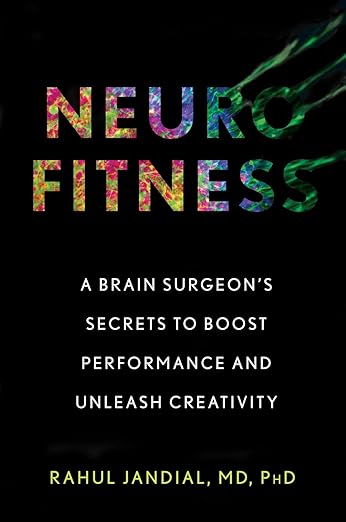
What if your brain could train like your body?
In Neurofitness, neurosurgeon and neuroscientist Dr. Rahul Jandial blends cutting-edge neuroscience with actionable advice — along with fascinating stories from his own operating room — to help you sharpen your mind, boost mental performance, and live with more focus, clarity, and resilience.
OPENING THOUGHTS
This is my first time picking up a book that dives into medical and scientific topics, especially one written by a neurosurgeon. I usually lean toward books on psychology or personal development, but this time I’m stepping into something a little more technical. The brain has always fascinated me — it’s so powerful, yet still full of mystery. I’m excited (and a bit nervous) to see how much I’ll understand, and I’m really hoping this book will open up a whole new way of looking at how the mind works, especially from a more scientific perspective.
PROLOGUE
- This book is the authors attempt to fight against a cause that no amount of surgery or science is going to fix: the phony claims, the brain science BS that we can very easily find in the media
- The bain’s complexity is unparalleled and vast. There are as many brain cells as there are stats in the Milky Way
1. AN ANATOMY LESSON LIKE NO OTHER
- The brain does not sit inside the skull, it floats, protected by a natural shock absorber called cerebrospinal fluid (CSF). The ‘nourishing liquor’ that is produced at a rate of about 2 cups per day
- The cerebral cortex covers the entire outer surface of your brain, like a thin, wrinkled blanket or skin wrapped around it
- It handles consciousness, langage, perception, thought… the big, important stuff
- The cerebral cortex is wrinkly and looks folded becasue it permits a greater surface area (otherwise, it would be the size of an extra-large pizza!)
- The cortex is divided into 4 sections (or lobes) that each have their own set of tasks. However, when we see the brain from the top, it is also divided into a left and right half, connecting the two halves
- The frontal lobe: the lobe most unique to humans, plays a primary role in motivation and reward-seek-behaviors
- Parietal lobe: controls sensation
- Fun fact: the surface of the brain has no pain receptors
- Occipital lobe: the brain’s visual processing center
- An injury or stroke to both left and right occipital lobes causes blindness, even if the eyes work fine
- Temporal lobe: processing of sounds in general and the understanding of speech in particular
- Deep inside the brain, underneath the cortex, serve in part as transit hubs for signals coming from and going to the spinal cord. They modulate and fine-tune those messages
- Hippocampus = memory and learning
- Amygdala = intense emotion hub, expecially fear and anger
- Thalamus = relays messages from body to brain
- Hypothalamus = controls hunger and hormones that control blood pressure, body temperature, growth, etc…
- Brain stem = controls breathing, heartbeat, sleeping, pain sensivity… basic life stuff
- Cerebellum = coordinates movement, coordination, timing and balance. Also plays an important role in mental and emotional functions – refining thoughts and emotions just as is does movements
2. BEYOND MEMORY AND IQ
- In 1984, James R. Flynn discovered that the average IQ level had been steadily rising about three points per decade
- The ‘Flynn effect’ – people have simply gotten better at taking tests. Improved teaching methods, the introduction of kindergarden and preschool, and higher education rates have all resulted in young people simply testing better
- Flynn also insists that kids are also getting smarter because of better nutrition and fewer childhood illnesses
- That means that human being are indeed getting smarter, and intelligence is not determined simply by DNA
- As science journalist Daniel Goleman explained in his bestseller, emotional intelligence is the ability to ‘rein in emotional impulse; to read another’s innermost feelings; to handle relationships smoothly.’
- Those qualities have their basis in the brain, primarly in the frontal lobe. The frontal lobe is also where our emotional and social self-control emerges
There are as many paths to success (and failure) as there are human beings. The smarter you are, the better your chances. The more emotionally balanced, the better. The grittier your determination to overcome obstacles and the longer you practice, the better you’ll do. (…) the entire brain must work together as a harmonious, integrated whole.
Page 36
3. THE SEAT OF LANGUAGE
- Fun fact: people who learn a second laguage gain significant benefits in cognitive health that last a lifetime
- Improved attention
- Improved learning
- Protection against dementia
4. UNLEASH CREATIVITY
In this chapter, we realize how dependent we all are on the delicate architecture of our brains. The brain gives, and the brain takes away. We like to think of our most advanced abilities – our creativity, our intelligence – as something that defines us, something that we personally brought into being. Nobody says that a person ‘had’ creativity; we say he or she ‘is’ creative. But let a tumor grow between our frontal lobes, and we learn – surprise! – those great gifts were simply on loan. Amazingly, disrupting one frontal lobe can leave prople functioning normaly. It’s what both frontal lobes do in concert that sprouts our highest cognitive function: creativity.
- Rooted in our collective beliefs, it is said that the right side of the brain is the creative or artistic side, and the left brain is the logical, analytical side, and that each of us tuen to favor one or the other
- This is FALSE – while it is true that parts of the left hemisphere are intimately involved in spoken language and in mathematical tasks, math geeks and computer programmers use both sides of their brain equally, as do painters and poets
- Lucid dreaming can be used as a portal where subconscious creativity can be accessed for creative insights
- ‘You must resolve the problem of sleeping without sleeping’ – Salvador Dali
- Rule followers are like good drivers: they keep their thoughts in their own lanes. As a consequence, it inhebits the random, out-of-left-field connections that define true creativity
- Daydreamers are not only more creative, but they’ve even shown to be smarter on certain tests
- Unstructured free play in childhood is a foundation of adult creativity
- Creativity requires the confidence to know that mistakes happen and are part of the process. Fear or failure keeps to many people from daring to express themselves
5. SMART DRUGS, STUPID DRUGS
- About ‘smart’ drugs: dose does matters, and so do the age and genetic predisposition of the person taking it. Not everything natural is good, and not every chemically synthesized drug is bad
6. SLEEP ON IT
- Sleep is a firestorm of brain activity. While sleeping, our brain’s subconscious is occupied defragging, deleting, and storing the prior day’s doings for long-term retrieval (…)
- The brain never rests
- The only people whose brains are truly resting are those who are placed in a chemical coma
- Often, the brain’s refusal to settle down, awake or asleep, is a big problem for most of Dr. Jandial patients
- Freud stated that dreams are the symbolic manifestation of our fears, desires, anxieties, and repressed childhood memories. They are the place where our sexual desires and other wishes of supremacy (the part of our personality he called the ‘Id’) do battle with that part of our personality that tries to censor and supress the Id
- Scientifically speaking, we still don’t understand why we dream
7. JUST BREATHE
- Mindful breathing can benefit anyone and everyone. First introduced by Buddha over 2500 years ago, it is a fundamental part of mindfulness meditation, focusing the mind on the present
- Mindful breathing improves the very structure, pshysiology, and function of your brain
- Studies have found that during mindful breathing, connections were strengthened between the amygdala (an area where strong emotions are processed) and the prefrontal cortex (the brain’s chief executive officer). This proves how mindful breathing helps the frontal lobe stiffle negative emotions
- Not only that, meditative beathing can even increase white matter connection
- As they say, the best things in life are free !
8. HOW TO HANDLE HEAD INJURIES
- Awareness and prompt action are crucial in mitigating the effects of head injuries
9. FOOD FOR THOUGHT
- Ketogenic diet: while the author supports limiting carbs and the emphasis on eating plants. Limiting fat and protein is however not something he recommends because you’re trading one problem for another: too many calories and bad cholesterol
- The MIND (Mediterranean-DASH Intervention for Neurodegenerative Delay) diet: a diet specially designed to improve brain health. Big on fresh fruits, begetables, nuts, fish, and chicken, and down on red meat, saturated fats and sweets
- Intermittent fasting: there is perhaps a reason why most of the world’s major religions call for periodic fasting. Intermittent hunger clears the mind, awakens the sense, and improves brain functioning. Plus it lowers your blood sugar, reduces insulin levels, and helps you lose weight by reducing total calories
- Going without food for even a day increases your brain’s natural growth factors, supporting the survival and growth of neurons
10. HOW THE BRAIN HEALS ITSELF
- Fun fact: the brain can still perfectly function even after removing half of it (hemispherectomy). When the physical structure of the brain is manipulated, or even removed, the remaining members of the neuronal orchestra can still work in concert to produce an amazing symphony of thought, imagination, and emotion
- Some ways to build your neuroplasticity
- Use your nondominant hand more often: this will force the movement areas of your cerebral cortex to recruit idle neurons to the task
- Acquire a new laguage: excellent way to exercise the neuroplasticity of your left temporal lobe
- Use your GPS less often: great way to develop spatial orientation skills. There are unique neurons (called grid cells) that are used for navigating your way through a city or a subway. Also, grid cells are part of the neuronal tissue that is lost in Alzheimer’s
11. THE BIONIC BRAIN
‘Reset Your Vagal Tone’
- Your brain has 12 cranial nerves, and the 10th one is called the vagus nerve — or the “wandering nerve.”
- It’s special because it goes way beyond your face, reaching your heart, lungs, and gut.
- This nerve helps control your heart rate, especially when you’re stressed or relaxed.
→ Half its fibers help calm you down when you’re resting. - Buddhist monks and others who meditate a lot can lower their heart rate just by using their mind — through this nerve.
But why is it important?
- The vagus nerve is a two-way street:
- It sends calming signals from your brain to your body
- But also from your body back to your brain (like from your lungs and heart).
- So when you breathe deeply and mindfully, your lungs send signals to your brain that tell it to calm down.
- This can actually change how your brain is reacting, reduce stress, and make you feel more at peace.
→ That’s what they call a “network reset.”
So…
You don’t need fancy machines or brain implants — you already have the power to change how you feel and think using your breath and focus.
Your brain came with that feature built in.
12. SHOCK AND TINGLE
- Doctors in the emerging field of ‘nutritional therapy’ can prescribe diets (like the MIND diet) that can lessen anxiety and improve your mood. Those diets consists of fruits, vegetables, seafood, and whole grains; less meat, fried food, carbs, and fat
- Your ‘comfort foods’ may not bring that much comfort !
13. STEM CELLS AND BEYOND
- Stem cells are capable of turning into any mature cell. They are the progenitors of all the other cells in your body, whether bone, skin, brain, or muscle
- Neural stem cells (NSC) are slightly different: they can become any type of cell found in the nervous system, including any type of neuron in the brain
- Dr. Jandial remains postitive that the human brain can in fact keep producing neurons, in select regions of the brain, throughout life
14. THE YOUNGER BRAIN
- Some regions in the brain are completed much earlier than others, and the frontal lobes are the last to receive the finishing touches. The prefrontal cortex of the brain, the most complicated region (providing us with cognition and judgment), demands the most time for sculpting
The great culling (simplified)
The brain doesn’t just grow — it also lets go of what it doesn’t need
- Brain growth includes ‘death’ too
- When a baby’s brain is forming (during pregnancy), it creates way more neurons than it needs.
- Later, the brain removes the extra ones — like trimming a tree.
- This is called “pruning.”
- Only the strongest, most useful neurons survive.
2. Use it or lose it
- Neurons that get used (for skills, breathing, memory, vision, etc.) get stronger.
- Neurons that don’t get used shrivel and die.
3. What happens when pruning goes wrong?
- Too little pruning (like in autism): Too many connections remain. The brain may become overloaded in some areas.
- Too much pruning (like in schizophrenia): Important connections may be lost, leading to problems like hallucinations or delusions.
15. THE OLDER BRAIN
- Our brain is bathed in cerebrospinal fluid (CSF), also called the ‘nourishing liquor’ because it’s rife with growth factors that keeps your neurons fertilized
- As exercise regimen with both aerobic and resistance training has been shown to be the best way to keep your brain’s nourishing liquor at full strength
- There are four kinds of memory:
- Semantic memory: general knowledge about the world. This huge knowledge base not only remains generally stable in an older adult but can continue to grow as a person learns more
- Procedural memory: knowledge of how to do things. Once learned, procedural memories tend to remain solid as a rock
- Episodic memory: your recollection of events. Episodic memory peaks in your midtwenties and the slowly declines throughout life
- Not all the brain changes in older people are bad: research found that older adults have a greater sense of well-being and greater emotional stability than do teens or young adults
- ‘Physical health goes down, cognitive habilities go down, but happinness increases with age, satisfaction with life increases with age. That’s due in part to the growth of wisdom about what really matters’ – Dilip Jeste
- What’s good for the heart is actually very good for the brain. What keeps your heart arteries open keep the brain arteries open aswell
- The reason why education pays off is because something called cognitive reserve: people with extra brain power can afford to lose more before showing obvious signs of decline
CLOSING THOUGHTS
Neurofitness gave me a fresh, fascinating look into the world of neuroscience. The stories Dr. Jandial shared — especially from the operating room — were not only memorable, but added so much life to the science. I learned some incredible things about how the mind and brain work, and it genuinely shifted the way I think about mental performance and well-being. Some concepts were a bit hard to grasp at times (especially the more technical ones), but overall, this was a powerful and eye-opening read.
 YAZ LOGS
Leave a comment