
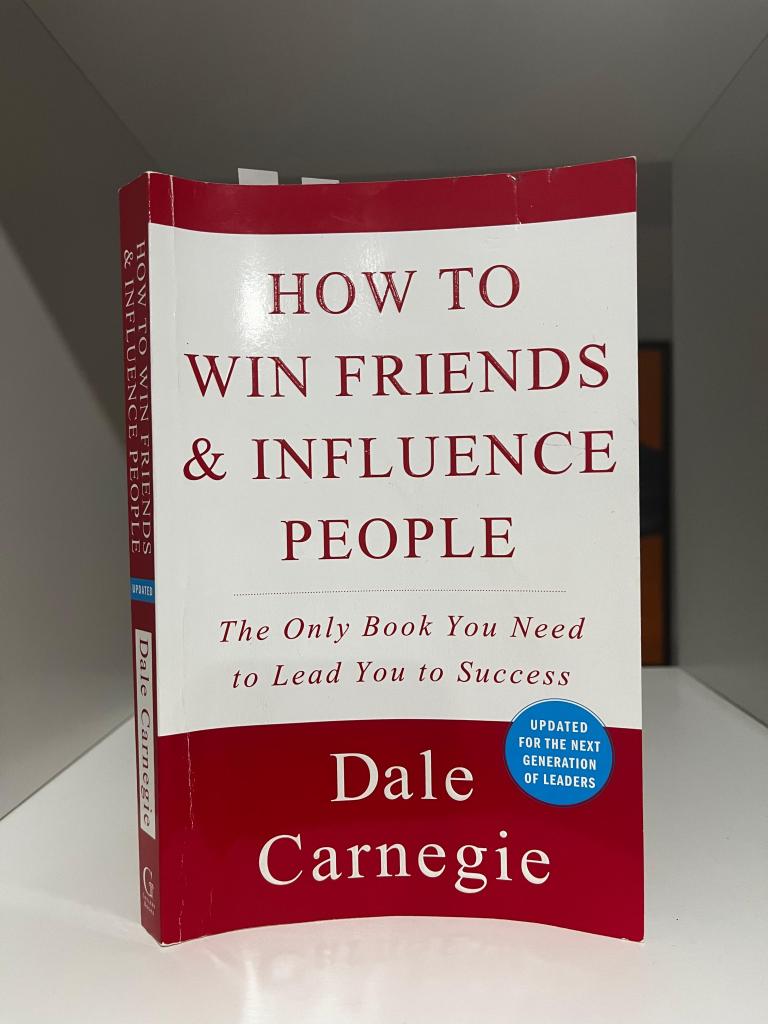
‘The More You Get Out of This Book, the More You’ll Get out of Life!’
How to Win Friends and Influence People by Dale Carnegie is a timeless guide to improving interpersonal relationships and communication. By focusing on empathy, active listening, and positive reinforcement, Carnegie teaches readers how to build genuine connections and succeed both socially and professionally.
PERSONNAL OPENING THOUGHTS
I have to admit, I approached this book with a bit of skepticism. Perhaps it was the somewhat flashy title or the mixed opinions I had heard, though I always try to keep an open mind when it comes to books. Still, curiosity got the best of me, and I decided to give it a chance. Who knows? Maybe it will surprise me and offer valuable insights.
INTRODUCTION
In the 20th century, the University of Chicago and the United YMCA Schools conducted a study to determine what adults want to study. That study revealed that the second most popular interest amongst those adults, after health, is how to understand and get along with people; how to make people like you, and how to win others to your way of thinking.
- ‘Education is the ability to meet life’s situations.’ Dr. John G. Hibben, former president of Princeton University
- If you want to get the most out of this book, you just need a deep desire to learn and to be determined to increase your ability to deal with people
- Remind yourself constantly how important these principles are to you. Visualize how it will lead you to a happier and more fulfilling life
- That will require time, persistence and patience
- Every Saturday night, Dale Carnegie devoted his time to write in his engagement book, a way to self examinate and review himself. He would respond to those questions: what mistakes did I make? ; what did I do that was right-and in what way could I have improved my performance? ; what lessons can I learn from that experience?
- This weekly routine helped him improve his ability to make decisions, and aided him with his relationships
PART ONE
FUNDAMENTAL TECHNIQUES IN HANDLING PEOPLE
- ‘If You Want to Gather Honey, Don’t Kick Over the Beehive’
- 99% of the time, people never criticize themselves for anything, no matter how wrong they are
Criticism is futile because it puts a person on the defensive and usually makes him strive to justify himself. Criticism in dangerous, because it wounds a person’s precious pride, hurts his sense of importance, and arouses resentment.
Page 5
- Numerous studies, like the ones done by the world-famous psychologist B. F. Skinner proving that an animal rewarded for good behavior will learn and retain more rapidly and efectively with rewards rather than with punishments, showed that the same principle applies for humans
- ‘As much as we thirst for approval, we dread condemnation’ – Hans Selye
- Not only the resentment caused by criticism can demoralize people but it also does not change anything about the situation
- Critisims are like homing pigeons. They always return home.
- When you really think about it, from a purely selfish standpoint, improving yourself is far more beneficial for you than trying to change others (and a lot less dangerous)
- ‘Don’t complain about the snow on your neighbor’s roof, when your own doorstep is unclean’ – Confucius
- Remember this when you are dealing with people: we are not creatures of logic but creatures of emotion consumed by pride and prejudices
- Anyone can criticize, condemn and complain, but it takes character and self-control to be understanding and forgiving
- ‘A great man shows his greatness by the way he treats little men.’ – Carlyle
- Even God does not judge a person until the end of his life, so why should we?
PRINCIPLE 2 : DON’T CRITICIZE, CONDEMN OR COMPLAIN
2. ‘The Big Secret of Dealing with People’
- The only way you can get someone to do anything you want is by giving them what they want
- Sigmund Freud said that every desire comes from two motives: the sex urge and and desire to be great
- America’s most profound philosopher said that the deepest urge in human nature is ‘the desire to be important‘
- Some of the things people want the most:
- Health
- Food
- Sleep
- Money
- Life in the hereafter
- Sexual gratification
- The well-being of our children
- A feeling of importance
→ All of those wants are usually met, except one: the craving to be appreciated, the desire to be important. This want is one the the most distinguishing difference between humankind and animals. If our ancestors had not had this craving of importance, there would not even be a civilization
- It is that very desire that makes you want to wear the latest styles, buy the nicest cars, and talk about your briliant children. That very desire that often makes people want to join gangs and engage in criminal activities
- If you tell me how you get your feeling of importance, I’ll tell you what you are. That determines your character.
- People can even go insane in search for a feeling of importance that they did not receive in the real world
I consider my ability to arouse enthusiasm among my people. The greatest asset I possess, and the way to develop the best that is in a person is by appreciation and encouragement.
Charles Schwab
- Once I did bad and that I heard ever/Twice I did good, but that I heard never
- We often take our loved ones so much for granted that we never let them know we appreciate them
- Appreciation and flattery: one is sincere, unselfish and comes from the heart, the other one is insincere, selfish, and comes from the mouth. One is universally admired; the other universally condemned
- ‘Don’t be afraid of the enemies who attack you. Be afraid of the friends who flatter you.’ – Mexican hero General Alvaro Obregon
- Flaterry is telling the other person what you think about yourself
- ‘Every man I meet is my superior in some way. In that, I learn of him’ – Emerson
PRINCIPLE 2 : GIVE HONEST AND SINCERE APPRECIATION
3. ‘He Who Can Do This Has the Whole World with Him. He Who Cannot walks a Lonely Way’
- The only way on earth to influence people is to talk about what they want and show them how to do it
- It’s simple: we are interested in what we want
- Before you try persuading someone to do something, ask yourself : ‘How can I make this person want to do it?‘
- ‘If there is any one secret of success, it lies in the ability to get the other person’s point of view and see things from that person’s angle as well as from your own‘ – Henry Ford
- The world is so full of selfish and self-seeking people, that the person who unselfishly tries to serve others has an enormous advantage, and little competition
- This is not manipulation, each party should gain from the negotiation
PRINCIPLE 3 : AROUSE IN THE OTHER PERSON AN EAGER WANT
PART TWO
SIX WAYS TO MAKE PEOPLE LIKE YOU
1. ‘Do This and You’ll Be Welcome Anywhere’
- The greatest winner of friends in the world: the dog. When you really think about it, the dog is the only animal that doesn’t have to work for a living (like the cow who has to give milk, or the hen to lay eggs) ; it makes it’s living by giving you nothing but love
- You make more friends by becoming interested in people than when you are trying to get other people interested in you
- Remeber: people are not interested in you, they are interested in themselves
- Succesfull authors, performers, salespeoples, etc… are people who are genuinely interested in others and who like them
A show of interest, as with every other principles of human relations, must be sincere. It must pay off not only for the person showing the interest, but for the person receiving the attention. It is a two-way street both parties benefit.
Page 61
PRINCIPLE 1 : BECOME GENUINELY INTERESTED IN OTHER PEOPLE
2. A Simple Way to Make a Good First Impression
- The expression on ones face is far more important that the clothes on wears on one’s back
- What a smile says: ‘I like you. You make me happy. I am glad to see you‘
People who smile tend to manage, teach and sell more effectively, and to raise happier children. There’s far more information in a smile than a frown. That’s why encouragement is a much more effective teaching device than punishment.
Professor James V. McConnell, psychologist
- You must have a good time meeting people if you want them to have a good time meeting you
- Your smile is a messenger of your good will, and brightens the lives of all who sees it, like a sun breaking through the clouds
PRINCIPLE 2 : SMILE
3. If You Don’t Do This, You Are Headed for Trouble
- We are far more interested in our own name than all other names on earth put together
- Very often, the bigger a corporation gets, the colder it becomes. One way to ‘warm it up’ is to remember people’s names. The executive who cannot remember names cannot remember a significant part of their business
- People are so proud of their names that they want to perpetuate them at any cost
- The name sets the individual apart ; it makes the person unique among others
- ‘Good manners are made up of petty sacrifices‘
PRINCIPLE 3 : REMEMBER THAT A PERSON’S NAME IS TO THAT PERSON THE SWEETEST AND MOST IMPORTANT SOUND IN ANY LANGUAGE
4. An Easy Way to Become a Good Conversationalist
- ‘Few human beings are the proof against the implied flattery of rapt attention‘ – Jack Woodford
- People will consider you as a good conversationalist just by being a good listener and by encouraging others to talk
- Listening should not be just mere silence, but a form of activity
- Hear with your eyes and ears
- Even the most violent critic will soften and subdue in the presence of a patient, sympathetic listener
- Very often, people are so concerned about what they are going to say next that they don’t keep their ears open
- People prefer good listeners to good talkers
- The only thing we often want is to just being listened to
- If you aspire to be a good conversationalist: be an attentive listener ; ask questions that the other person will enjoy answering, encourage them to talk about themselves and their accomplishments
- To be interesting you need to be interested
- Remember: the people you are talking to are a hundred times more interested in themselves, their wants, and their problems than yours
PRINCIPLE 4 : BE A GOOD LISTENER. ENCOURAGE OTHERS TO TALK ABOUT THEMSELVES
5. How to Interest People
- Whenever Theodore Roosevelt expected a visitor, we would sit up late at night in order to read on the subjects he knew the guest was particularly interested in
- The royal road to a persons heart is to talk about the things he or she treasures most
PRINCIPLE 5 : TALK IN TERMS OF THE OTHER PERSON’S INTERESTS
6. How to Make People Like You Instantly
- Always make the other person feel important
- ‘Do unto others as you would have them do unto you.’
- Almost everyone considers themselves important, make them feel like so
The unvarnished truth is that almost all the people you meet feel themselves superior to you in some way, and a sure way to their hearts is to let them realize in some subtle way that you recognize their importance, and recognize it sincerely.
Page 98
- Sad truth: very often those who have the least justification for a feeling of achievement tend to bolster up their egos
- ‘Talk to people about themselves, and they will listen for hours’ – Disraeli
PRINCIPLE 6 : MAKE THE OTHER PERSON FEEL IMPORTANT – AND DO IT SINCERELY
PART THREE
HOW TO WIN PEOPLE TO YOUR WAY OF THINKING
1. You Can’t Win an Argument
- You get the best of an argument when you avoid it
- Nine times out of ten, an argument always ends with each party more firmly convinced that they are absolutely right
- You can’t win an argument: if you lose you lose; and if you win, you lose too because you made the other person feel inferior and hurt their pride. They will resent your triumph
A man convinced against his will
Is of the same opinion still
- ‘Hatred is never ended by hatred but by love‘ – Buddha
- How to keep a disagreement from becoming an argument:
- Welcome the disagreement – perhaps it is an opportunity to be corrected if you are mistaken
- Distrust your first instinctive impression – our first natural reaction in a disagreement is to be defensive. Keep calm and watch out for your fist reaction: it may be your worst
- Control your temper – you can measure the size of a person by what makes them angry
- Listen first – try to build bridges of understanding
- Look for areas of agreement
- Be honest – and reduce your defensiveness
- Promise to think over your opponents’ ideas and study them carefully
- Thank your opponents sincerely for their interest
- Postpone action to give both sides times to think through the problem – ask yourself if your opponent could be right, and how will your reaction influence the outcome
PRINCIPLE 1 : THE ONLY WAY TO GET THE BEST OF AN ARGUMENT IS TO AVOID IT
2. A Sure Way of Making Enemies – and How to Avoid It
- Telling someone they are wrong will only hurt their pride and self-esteem. Your will not change their opinions, only hurt their feelings
One thing only I know, and that is that I know nothing
P. 117
- You will never get into trouble by admitting that you may be wrong. By doing so, you will stop any argument and inspire your opponent to be open minded too
- We are not logical creatures: we are driven by biases and prejudices
PRINCIPLE 2 : SHOW RESPECT FOR THE OTHER PERSON’S OPINIONS. NEVER SAY, ‘YOU’RE WRONG’
3. If You’re Wong, Admit It
- It is satisfying to have the courage to admit our faults. It not only clears any room for guilt and derensiveness, but also helps solve the problem created by the mistake
- Any fool can try to defend his or her mistakes – and most fools do
- If you are wrong, admit it quickly and emphatically
- By fighting you never get enough, but by yielding you get more than you expected
PRINCIPLE 3 : IF YOU ARE WRONG, ADMIT IT QUICKLY AND EMPHATICALLY
4. A Drop of Honey
- ‘If you come at me with your fists doubled, I think I can promise you that mine will double as fast as yours’ – Woodrow Wilson
- Nobody can be forced to agree with you ; but they can certainly led to by you being gentle and friendly
- A drop of honey catches more flies than a gallon of gall
- Friendliness leads to friendliness
PRINCIPLE 4 : BEGIN IN A FRIENDLY WAY
5. The Secret of Socrates
- When talking with others, begin by emphasizing on the things on which you agree and make them understand that you are both striving for the same end goal
- Get the other person say ‘YES‘ as much as possible, it places their organism in a forward-moving, accepting and open attitude
- A ‘NO‘ response is a difficult handicap to overcome, it means that the whole organism gathers itself into a condition of rejection
- The Socratic method is based upon getting a ‘yes, yes’ response
- ‘He who treads softly goes far’
PRINCIPLE 5 : GET THE OTHER PERSON SAYING ‘YES, YES’ IMMEDIATELY
6. The Safety Valve in Handling Complaints
- Most people, when trying to win others to their way of thinking, talk too much and interrupt, and don’t listen enough. Let others talk ; they know more about their business and problems than you do. Ask them questions, be open minded (and be sincere about it) and let them teach you a thing or two. Let them express their ideas fully and freely
- Even our friends would much rather talk to us about their achievements than listen to us boast about ours
- ‘If you want enemies, excel your friends; but if you want friends, let your friends excel you’ – La Rochefoucauld
PRINCIPLE 6 : LET THE OTHER PERSON DO A GREAT DEAL OF THE TALKING
7. How to Get Cooperation
- We have much more faith in ideas that we discover by ourselves than in ideas that are handed to us on a silver platter
- It is much more wiser to make suggestions to others, and let them think of the conclusion
- No one likes the feeling of being sold something, we prefer the feeling that we are buying on our own will
- Let people sell to themselves
PRINCIPLE 7 : LET THE OTHER PERSON FEEL THAT THE IDEA IS HIS OR HERS
8. A Formula That Will Work Wonders for You
- By putting yourself in others’ shoes, you become much more tolerant
- Success in dealing with people depends on a sympathetic grasp of the other person’s viewpoint
- In a conversation, cooperation arises when you show that you consider the other person’s ideas and feelings
PRINCIPLE 8 : TRY HONESTLY TO SEE THINGS FROM THE OTHER PERSON’S POINT OF VIEW
9. What Everybody Want
- By saying to the other person that you don’t blame them for feeling as they do and that if you were them you would feel as they do, you will eliminate ill feelings, arguments and make the other person listen attentively
- People are thirsting for sympathy, give it to them, and they will love you
PRINCIPLE 9 : BE SYMPATHETIC WITH THE OTHER PERSON’S IDEAS AND DESIRES
10. An Appeal That Everybody Likes
- A person has two reason for doing something: one that sounds good and a real one
- People like to see themselves as good, honest, and fair
- Instead of criticizing or demanding, frame your request in a way that aligns with their higher values (e.g., fairness, generosity, integrity)
- Example: If a store refuses to refund you, instead of arguing, say: “I know you’re a fair and understanding business that cares about customers, so I’m sure you’ll help me out.”
PRINCIPLE 10 : APPEAL TO THE NOBLER MOTIVES
11. The Movies Do It. TV Does It. Why Don’t You Do It?
- Plain facts often don’t capture attention—make them vivid and engaging
- Use stories, analogies, or visual demonstrations to make your point more compelling
PRINCIPLE 11 : DRAMATIZE YOUR IDEAS
12. When Nothing Else Works, Try This
- The way to get things done is to stimulate competition, with a desire to excel
- Think of the concept of the ’employee of the month’ in companies ; a good way to stimulate competition amongst workers and to keep the company moving forward
- Every successful person loves the game, the chance for self-expression, to prove their worth, to excel, to win. The desire for a feeling of importance
PRINCIPLE 12 : THROW DOWN A CHALLENGE
PART FOUR
BE A LEADER: HOW TO CHANGE PEOPLE WITHOUT GIVING OFFENSE OR AROUSING RESENTMENT
1. If You Must Find Fault, This Is the Way to Begin
- A barber lathers a man before he shaves him
- Before critizising someone, start by praisings and appreciations, it makes the person more receptive
- Example: Instead of saying, “Your reports are too disorganized,” say:
“I really appreciate the effort you put into your reports. One small improvement could make them even clearer…”
- Example: Instead of saying, “Your reports are too disorganized,” say:
PRINCIPLE 1 : BEGIN WITH PRAISE AND HONEST APPRECIATION
2. How to Criticize – and Not Be Hated for It
- Avoid direct criticism—it can make people defensive
- Subtle suggestion : In order for the other person to not question the original praise before the criticism, say and instead of but
- This is a good way to indirectly call anothers’ person mistake
PRINCIPLE 2 : CALL ATTENTION TO PEOPLE’S MISTAKES INDIRECTLY
3. Talk About Your Own Mistakes First
- Admitting your own mistakes makes you relatable and less threatening
- It shows humility and encourages the other person to accept feedback more openly
- Example: Instead of saying, “You shouldn’t have handled the customer like that,” say:
“I remember when I struggled with handling customers too—I once made a similar mistake…”
- Example: Instead of saying, “You shouldn’t have handled the customer like that,” say:
PRINCIPLE 3 : TALK ABOUT YOUR OWN MISTAKES BEFORE CRITICIZING THE OTHER PERSON
4. No One Likes to Take Orders
- Don’t give orders, give suggestions
- Rather than telling people ‘Do this‘ or ‘Don’t do that‘ ; say ‘You might consider this‘ or ‘Do you think that would work?’
- Always give people the opportunity to do things themselves. Let them learn from their mistakes. This technique saves a person’s pride and feeling of importance and it makes them easier to correct their faults while encouraging cooperation
- Resentment caused by a brash order may last a long time
Asking questions not only makes an order more palatable ; it often stimulates the creativity of the persons whom you ask. People are more likely to accept an order if they have had a part in the decision that caused the order to be issued.
Page 209
PRINCIPLE 4 : ASK QUESTIONS INSTEAD OF GIVING DIRECT ORDERS
5. Let the Other Person Save Face
We ride roughshod over the feelings of others, getting our own way, finding fault, issuing threats, criticizing a child or an employee in front of others, without even considering the hurt to the other person’s pride.
Page 211
- Even if we are right and the other person is wrong, the only thing we do by making someone lose face is destroy their ego
I have no right to say or do anything that diminishes a man in his own eyes. What matters is not what I think of him, but what he thinks of himself. Hurting a man in his dignity is a crime.
Antoine de Saint-Exupéry
PRINCIPLE 5 : LET THE OTHER PERSON SAVE FACE
6. How to Spur People On to Success
- Praising even the slightest bit of improvement inspires the other person to keep on improving. It can literally transform them
- ‘Praise is like sunlight to the warm human spirit ; we cannot flower and grow without it’ – Jess Lair, psychologist
- Specific praise comes across as sincere and from the heart. Even if we all praise for appreciation and recognition, we despise insincerity and flattery
PRINCIPLE 6 : PRAISE THE SLIGHTEST IMPROVEMENT AND PRAISE EVERY IMPROVEMENT. BE ‘HEARTY IN YOUR APPROBATION AND LAVISH IN YOUR PRAISE’
7. Give a Dog a Good Name
- The average person can be led easily if you have their respect and if you show that you respect them in return
- Assume and state openly that other people have the virtue you want them to develop
- ‘Give a dog a bad name and you may as well hang him.’ But give him a good name-and see what happens.
PRINCIPLE 7 : GIVE THE OTHER PERSON A FINE REPUTATION TO LIVE UP TO
8. Make the Fault Seem Easy to Correct
- By telling another person that they are stupid, has no gift for it, and is doing it all wrong, you destroy every motivation for them to try to improve. But if you use the opposite technique – being liberal with your encouragement, make the thing seem easy to do and letting the person know that you have faith in their ability – they will practise until the dawn comes in the window in order to improve and excel
PRINCIPLE 8 : USE ENCOURAGEMENT. MAKE THE FAULT SEEM EASY TO CORRECT
9. Making People Glad to Do What You Want
- Always make the other person happy about the thing you suggest
- ‘Men are ruled by toys’ – Napoleon Bonaparte
- Guidelines that effective leaders should follow when they need to change attitudes or behaviors of others
- Be sincere – don’t promise anything that you cannot deliver
- Know exactly what you want the other person to do
- Be empathetic
- Consider the benefits the other person will receive if they do what you suggest
- Match those benefits to the other person’s wants
- When making your request, put it in a way that the other person will feel like they will personally benefit from it
PRINCIPLE 9 : MAKE THE OTHER PERSON HAPPY ABOUT DOING THE THING YOU SUGGEST
A SHORTCUT TO DINSTINCTION
- Any person can speak well in public if they are confident in their ideas that are boiling and stewing within them
- The best way to develop self-confidence is to do things that you are scared of doing and get a record of succesful experiences behind you
CLOSING THOUGHTS
I must admit, this is, by far, the most fascinating book I have read. Dale Carnegie’s storytelling, combined with his thought-provoking and engaging writing style is what makes this one of the most renowned self-help books of all time. His ability to illustrate profound concepts through real-life examples not only makes them easy to grasp but also encourages us to actively apply them in our own lives. It’s a book that doesn’t just inform, it inspires action.
I would recommend this book to anyone who wants to improve their social skills, build stronger relationships, and become more persuasive in both personal and professional life. Whether you’re a student, a leader, or simply someone looking to communicate more effectively, Carnegie’s timeless principles offer valuable insights that can truly make a difference.
 YAZ LOGS
Leave a comment