
Atomic Habits by James Clear is a comprehensive guide to understanding habits and how to effectively change them. The book delves into the science behind habits, explaining how they are formed and how they can be transformed. Clear provides practical strategies for making small changes that can lead to remarkable results. Overall, Atomic Habits serves as a valuable resource for anyone looking to understand the psychology of habits and make lasting changes in their lives.
OPENING THOUGHTS
As a person who strives to build healthy and long lasting habits wether it is for boxing, school or my personal life in general, I believe that this book will not only teach me how to do so but also help me to break some bad habits that I want to get rid of. I saw a lot of good reviews on this one, so I am excited to read this book.
atomic
- an extremely small amount of a thing; the single irreducible unit of a larger system.
- the source of immense energy or power.
habit
1. a routine or practise performed regulary; an automatic response to a specific situation
INTRODUCTION
- After the rehabilitation of a severe accident in highschool, Clear knew that if his life was going to improve, he was the only one responsible for it
- Being in college, while others stayed up late and partied, he built good sleeping habits and went to bed early each night
- These minor improvements gave him a sense of control over his life. He started to feel confident
- Small changes will lead to remarkable results, if you are willing to stick to them
- Small wins
- Same habits = same results
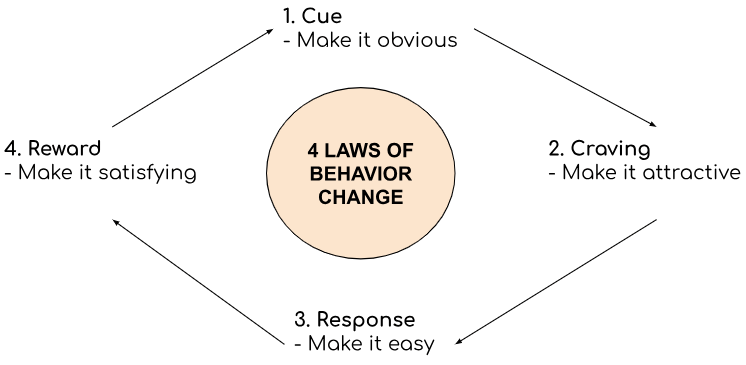
- Cue, craving, response, reward
- From ‘stimulus, response, reward’ by B. F. Skinner
- If you offer the right reward or punishment, you could get people to act in a certain way
THE FUNDAMENTALS: Why Tiny Changes Make a Big Difference
1) The Surprising Power of Atomic Habits
- We often believe that massive success requires massive action
- Improving by 1% can be far more significant in the long run
- 1% better every day = 37 times better after a year (imagine that in a course of 2, 5 or 10 years!)
- We often dismiss small changes because they don’t matter much in the moment
- Habits are like compound interest (it multiplies)
- You should be more concerned with your current trajectory than with your current results
- Good habits make time your ally; bad habits make time your enemy
- Valey of Disappointment
- The most powerful outcomes are delayed
- Your work is not wasted, it is just being stored
- Mastery requires patience
“When nothing seems to help, I go and look at a stonecutter hammering away at his rock perhaps a hundred times without as much as a crack showing in it. Yet at the hundred and first blow it will split in two, and I know it was not that blow that did it, but all that had gone before.”
Jacob Riis
- Breaking a bad habit is like uprooting a powerful oak within us, and building a good habit is like cultivating a delicate flower one day at a time
- Winners and losers have the same goals
- Focus on systems, the score will take care of itself
- Achieving a goal only affects your life for a moment
- Falling in love with the process make us keep playing the game
- You do not rise to the level of your goals, you fall to the level of your systems
- Treating a symptom without addressing the cause will lead you to chase the same outcome
- You get what you repeat
2) How Your Habits Shape Your Identity (and Vice Versa)
- It is often challenging to break our bad habits:
- We change the wrong thing
- We change them in the wrong way
- Layers of behavior change:
- Outcomes: results
- Processes: habits and systems
- Identity: beliefs, assumptions, and biases. Your worldview, self-image, judgments about yourself and others
- Outcomes are about what you get, processes about what you do and identity about what you believe
- Identity-based habits > outcome-based habits
- ‘I’m trying to quit’ VS ‘I’m not a consummer’
- Your past habits were part of your former life, not your current one
- The more pride you have in an aspect of your identity, the more motivated you will be to maintain the habits associated with it
- Your habits are a reflection of your identity
- The more you repeat a behavior, the more you reinforce the identity associated with it and have evidence of it
- Identity-based habits are a double-edged sword
- It can work for or against you
- What you tell to yourself is very important
- Ex. ‘I’m not good at math’ ; ‘I’m always late’
- You begin to accept them as facts and they become part of your identity
- If your habits conflict with your identity, you will fail to put them into action
- You don’t need a unanimous vote to win an election ; you just need a majority
- The focus should always to be on becoming that type of person, not getting a particular outcome
- Progress and becoming a better version of yourself requires constant unlearning and editing your beliefs, in order to upgrade and expand your identity
- Decide the type of persone you want to be
- Prove it to yourself with small wins
3) How to Build Better Habits in 4 Simple Steps
- Trial and error
- Try, fail, learn, try differently
- Practise = useful actions get reinfroced = habit forming = decrease of activity level in the brain when doing this practise = automation
- Our brain likes to pawn off tasks to the nonconscious mind to do automatically (our conscious mind can only pay attention to one problem at a time)
- ‘Habits are, simply, reliable solutions to recurring problems in our environment’ – Jason Hreha
- The primary reason the brain remembers the past is to better predict what will work in the future
- Process of building a habit:
- Cue (problem phase): triggers the brain to initiate a behavior, predicts a reward
- Our mind is constantly analyzing our internal and external environment to find rewards
- Craving (problem phase): motivational force behind every habit, crave in the internal state a habit delivers
- Response (solution phase): thought or action of the habit you perform
- Depends on motivation and ability
- Reward (solution phase): satisfy our cravings and teach us which actions are worth remembering in the future. Closes the feedback loop
- Our brain is a reward detector
- Cue (problem phase): triggers the brain to initiate a behavior, predicts a reward
THE 1ST LAW: MAKE IT OBVIOUS
1) The Man Who Didn’t Look Right
- The human brain is a prediction machine, continuously analyzing our sourroundings and important informations
- The more you repeat a habit the less likely you will question them and tend to overlook them (risk of failure)
- Behavior change comes with awarness
- ‘Until you make the unconscious conscious, it will direct your life and you will call it fate.’ – Carl Jung
- Pointing-and-Calling: raises the level of awarness from a nonconscious habit to a more conscious level
- There are no good habits or bad habits, only effective ones
- Don’t blame yourself for your faults and don’t praise yourself for your successes
- Exercise: Habits Scorecard – Pointing-and-Calling your own life events and routine
- Hearing your bad habits spoken out loud makes the consequences seem more real
5) The Best Way to Start a New Habit
- Implementation intention
- Plan on how you intend to implement a particular habit
- Time and location are the most common cues
- ‘I will (BEHAVIOR) at (TIME) in (LOCATION)’
- Setting a specific plan for when and where you will perform a new habit make you more likely to follow through (clarity)
- If we have hope, we have a reason to take action
- When your goals are vague, it’s easy to rationalize little exceptions
- Diderot’s effect: obtaining a new possession often creates a spiral of consumption that leads to additional purchases
- Human behavior: you often decide what to do next based on what you have just finished doing
- No behavior happens in isolation – cause and effect
- Habit stacking:
- Pair your new habit with a current one
- ‘After (CURRENT HABIT), I will (NEW HABIT)’
- Take advantage of natural momentum, select the right cue to kick things off (use the help of Habits Scorecard)
- Positive version of the Diderot’s effect
6) Motivation Is Overrated; Environment Often Matters More
- People often choose products not because of what they are but of where they are
- Kurt Lewin: Behavior is a function of the Person in their Environment
- B = f(P,E)
- Every habit is context and environment dependent
- Human’s perception is directed by the sensory nervous system, the vision being the most powerful
- Visual cues are the greatest catalyst of our behavior
- You don’t have to be the victim of your environment, you can be the architect of it, most people live in a world others have created for them
- Make the cue a big part of your environment
- Our behavior is defined not by the objects in the environment but by our relationship to them
- Think in terms of how you interact with the spaces around you
- Habits can be easier to change in a new environment
- ‘One space, one use’ – activity zones
- Avoid mixing the context of one habit with another
7) The Secret to Self-Control
- Disciplined people live in a way that does not require heroic willpower and self-control
- People with the best self-control are usually the ones who use it the least
- Self-control is a short-term strategy
- Bad habit: reduce exposure and cue
THE 2ND LAW: MAKE IT ATTRACTIVE
8) How to Make a Habit Irrestitible
- Supernatural stimuli: heightened version of reality
- In our society, we are victims of this phenomenon (fast-food, porn, social media, consumerism…)
- We have the brain of our ancestors but temptations they never had to face
- Instincts go wild
- Habits are a dopamine-driven feedback loop
- Dopamine plays a central role in many neurological processes (motivation, learning and memory, punishment, voluntary movement…)
- The reward system activated by the brain when you receive and anticipate a reward is the same
- Premack’s Principle: more probable behaviors will reinforce less probable behaviors
- Temptation bundling: linking an action you want and like to do with an action you need to do
- Habit stacking + temptation bundling:
- After (CURRENT HABIT), I will (HABIT I NEED)
- After (HABIT I NEED), I will (HABIT I WANT)
9) The Role of Family and Friends in Shaping Your Habits
- ‘A genius is not born, but is educated and trained.’ – Laszlo Polgar
- Humans are herd animals
- One of our deepest human desires is to belong
- Behaviors are attractive when they help us fit in
- We don’t choose our earliest habits, we imitate them:
- The close: the closer we are to someone, the most likely we are to imitate some of their habits. Invisible peer pressure
- Surround yourself with people who have the habits you want. Personal quest transforming into a shared one
- The many: the normal behavior of the tribe often overpowers the desired behavior of the individual
- The human mind knows how to get along with others
- The powerful: powerful people have more ressources, worry less about survival and are a more attractive mate
- Once we fit it, we start looking for ways to stand out
- The close: the closer we are to someone, the most likely we are to imitate some of their habits. Invisible peer pressure
10) How to Find and Fix the Causes of Your Bad Habits
- Our habits are modern-day solutions to ancient desires (instinctual human nature)
- ‘It is emotion that allows you to mark things as good, bad, or indifferent’ – Antonio Damasio
- Bad habits: they are attractive when we associate them with positive experiences
- Highlight the benefits of avoiding a bad habit to make it unattractive and associate with negative feelings
- Good habits: turn burdens into opportunities and highlight their benefits
- ‘I have to’ VS ‘I get to’
- Stress: ‘I am excited and I’m getting an adrenaline rush to help me concentrate’
- Motivation ritual: associating your habits with something you enjoy, craving will follow naturally
THE 3RD LAW: Make It Easy
11) Walk Slowly, but Never Backwards
- ‘The best is the enemy of the good’ – Voltaire
- We are often more focused on being in motion (planning, strategizing, learning) than being in action and delivering an outcome
- We stay in motion because it feels like we’re making progress without risking failure (delayed). We’re just preparing to take action
- Repetition is key, practise makes perfect
- Long-term potentiation: strengthening of connections between neurons in the brain based on recents patterns of activity (AKA a habit)
- From effortful practise to automatic behavior (automacy)
- Habits form based on frequency, not time
12) The Law of Least Effort
- Law of Least Effort: when deciding between two similar options, we tend to go towards the one that requires the least amount of work
- Our real motivation is to be lazy and to do what is convenient
- Energy is precious and the brain is wired to conserve it whenever possible
- The more energy required, the less likely it is to occur
- It is crucial to make your habits easy and convenient so that you’ll do them even when you don’t feel like it
- Have as many things working in your favor as possible
- Rather than trying to overcome the friction in your life, reduce it
- Environment design – prime your environment to make future actions easier
- Addition by substraction: remove points of friction taking your time and energy – achieve more with less effort
- Make bad habits difficult
13) How to Stop Procrastinating by Using the Two-Minute Rule
- The habits you follow without thinking often determine the choices you make when thinking
- Decisive moments set the options available to your future self
- Two-Minute Rule: when you start a new habit, it should take less than 2 minutes to do
- Make your new habits as easy as possible
- Mastering the habit of showing up
- Reinforces the identity you want to build
- Standarize before you optimize
- Combine the Two-Minute Rule with habit shaping
14) How to Make Good Habits Inevitable and Bad Habits Impossible
- Success is less about making good habits easy and more about making bad habits hard
- Commitment device: choice you make in the present that controls your actions in the future, prevents you to be controled by temptations
- Lock in the future behavior
- Best way to break a bad habit: make it impractical to do, increase the friction until you don’t have the option to act
- Automate your life as much as possible with the help of technology
THE 4TH LAW: Make It Satifying
15) The Cardinal Rule of Behavior Change
- Cardinal Rule of Behavior Change: what is immediatly rewarded is repeated. What is immediatly punished is avoided
- The human brain did not evolve to live in a delayed-return environment
- We are walking around with the same hardware as our Paleolithic ancestors, used to an immediate-return environment
- The world has changed much in the recent years, but human nature has changed little
- Time inconsistency: the way your brain evaluates rewards is inconsistent across time. You value the present more than the future
It almost always happens that when the immediate consequence is favorable, the later consequences are disastrous, and vice versa…. Often, the sweeter the first fruit of a habit, the more bitter are its later fruits.
Frédéric Bastiat, French economist
- The more immediate pleasure you get from an action, the more you should question whether it aligns with your long term goals
- Nearly in every field, success requires you to ignore an immediate reward in favor of a delayed reward
- The road less traveled is the road of delayed gratification
- The last mile is always the least crowded
- You need to work with the grain of human nature, not against it
- Immediate rewards are essential: they keep you excited while the delayed rewards accumulate in the backround (reinforcement)
- Change is easy when it is enjoyable
- The more a habit becomes a part of your life, the less you need outside encouragement and motivation to follow through
16) How to Stick with Good Habits Every Day
- Progress is more satisfying with visual measures
- Reinforces your behavior + adds immediate satisfaction (+evidence of your progress)
- Habit tracking is…
- Obvious: keeps you honest and creates a trigger that can initiate your next action
- Attractive: progress = motivation
- Satisfying: focusing on the progress rather than on the result
- Habit stacking + habit tracking formula:
- After (CURRENT HABIT), I will (TRACK MY HABIT)
The first mistake is never the one that ruins you. It is the spiral of repeated mistakes that follows. Missing once is an accident. Missing twice is the start of a new habit.
James Clear, Atomic Habits
- All-or-nothing cycle
- The ‘bad’ workouts are often the most important ones
- They are crucial; they reafirm your identity
- ‘When a measure becomes a target, it ceases to be a good measure’ Charles Goodhart
17) How an Accountability Partner Can Change Everything
- The more consequences and pain, the less likely the behavior
- Habit contract
- Holding your promises to yourself and others
ADVANCED TACTICS: How to Go from Being Merely Good to Being Truly Great
18) The Truth About Talent (When Genes Matter and When They Don’t)
- The secret to maximizing your odds of success is to choose the right field of competition, when it aligns with your natural inclinations and abilities
- Competence is highly dependent on context
- The strength of genetics is also their weakness
- We need to learn how to put them in our favor
Our environment determines the suitability of our genes and the utility of our natural talents. When our environment changes, so do the qualities that determine success.
James Clear, Atomic Habits
- Choose the habit that best suits you, not the one that is most popular
- Picking the right habit = easy progress = enjoyment = motivation
- Explore/exploit trade-off: after an initial period of exploration, shift your focus to the best solution, but always keep experimenting (10-20%)
- As you explore, ask yourself these questions:
- What feels like fun to me, but work to others?
- Whether you can handle the pain of the task easier than most, when you are enjoying while others suffer
- What makes me lose track of time?
- ‘In the zone’
- Where do I get greater returns than the average person?
- What comes naturally to me?
- When have I felt alive? When have I felt like the real me?
- What feels like fun to me, but work to others?
- When you can’t win by being better, you can win by being different
- The more you master a specific skill, the harder it becomes for others to compete with you
- Until you work as hard as those you admire, don’t explain their success as luck
19) The Goldilocks Rule: How to Stay Motivated in Life and Work
- The Goldilocks Rule: we experience peak motivation when working on tasks that are on the edge of our current abilities
- Not too easy, not too hard
- Improvement requires balance
- Professionals stick to the schedule; amateurs let life get in the way
- ‘Fair-weather worker’
20) The Downside of Creating Good Habits
- As habits form, it becomes easier to let mistakes slide
- We do things without thinking (double-edged sword)
- Habits + deliberate practise = mastery
- Importance of reflexion
- Without reflexion, we make excuses, create rationalizations, and lie to ourselves
- See the bigger picture
- Ex: Annual Review + Integrity Report
- ‘Keep your identity small’ Paul Graham
- When you spend your whole life defining yourself in one way and that disappears, who are you now?
- You identity works with the changing circumstances rather than against them
- Everything is impermanent – cycle of life
- A lack of self-awarness is poison. Reflexion and review is the antidote
CONCLUSION: The Secret to Results That Last
- Success is not a goal to reach or a finish line to cross (THERE IS NO FINISH LINE). It is an endless process and a system to improve and to refine
- ‘Happiness is the space between one desire being fulfilled and a new desire forming’ Caed Budris
- Peace = observation without craving
- ‘He who has a why to live for can bear almost any how’ Friedrich Nietzche
- Being curious is better than being smart
- Curiousness leads to action
- The primary mode of the brain is to feel; the secondary is to think
- We can only be rational and logical after feeling emotions
- At some point, all behavior is driven by emotions
- Cravings and suffering drives progress
- Actions speaks louder than words
- Reward is on the other side of sacrifice
CLOSING THOUGHTS
W-O-W! I absolutely loved this book. I would totally recommend this book to anyone. Even if you think you already practice good habits and do not have any bad ones, I believe that this book will still teach you a ton of interesting concepts and perspectives not only on the way you view your habits but also on your lifestyle in general.
 YAZ LOGS
Leave a comment